Droid Love, it’s like Palm love all over again

In February 2010 I bought a Motorola Droid smartphone.  I’m way into Droid love, which is like tech love, but more specific.  The Motorola Droid is a wonderful thing.

Even more wonderful, all this Droid love takes me back to the old days of the Palm PDA (personal device assistant!).  I loved my Palm devices.  I had a number of them, starting with a Palm Pilot and ending with a Palm TX.  I remember the websites, the print reviews, and the endless talk about what to get for your Palm.  These devices are all about apps, about what you put on them.  Most of the apps I put on my Palms were either inexpensive or free, just like the Droid.

I was a member of a Palm user group.  We had monthly meetings at Palm company headquarters.  2001 to 2005 were especially good years.  There were refreshments — pizza, cookies, chips, soft drinks and water. There were demos of new apps using a projector, with magnification and special lighting.  New devices got passed around.  We exchanged tips on how to do things.  My Palm user group was in Silicon Valley (northern California) but there were Palm user groups all over the world.

I went to three Palm development conferences, which were extra fun because I had no business or work relationship with Palm.  I took notes, using the Palm I had at the time.  Memories.

PalmSource Expo 2002.  The general public could attend.  Here’s the press release I copied to my calendar: “The PalmSource Expo, which will open its doors to the general public on Wednesday and Thursday, showcases the hottest new Palm Powered™ devices, software, peripherals and accessories – all in one place. More than 100 exhibitors present everything from handhelds, smartphones, and other mobile devices, to some of the most innovative travel, personal information management, education, entertainment, health, lifestyle, hobby and game software available for any platform”.

Wow – takes me back.

PalmSource Developer Conference 2004.  I went for one day because I got an affordable one day pass on eBay.   I still have the notes from the conference, note I took on my Palm.  Reading my notes – interesting – there’s starting to be a focus on “wireless” – that too takes me back!  In the old days, you got data on your Palm by connecting it to a PC.  Wireless was a new thing.

PalmSource Mobile Summit & DevCon 2005.  I went for free because I spent part of the time doing volunteer work, counting the number of people in a conference room.   We got a mini flash drive for attending.  We got PDF files of the talks, and MP3 files of the Computer Outlook Radio talk show, the shows that were done at PalmSource.   There are 17 sessions of about 20 minutes each, all talk.  Maybe we had longer attention spans in 2005.  I’m listening to one now, the interview with Howard Tomlinson from Astraware. The speakers are clear, but I can hear the conference going on in the background.   Howard is talking about Bejeweled for the Palm.  I still play that game

It was a Palm thing, now it’s a Droid thing. The Droid makes me feel the same way, though I don’t belong to a user group where we meet every month, and I’ve never been to an Android conference.  For a look at Droid love, look at the droid forums on http://www.droidforums.net.  People talk about the Motorola Droid and about other Android OS phones, with the save loving and obsessive zeal that I’ve seen with the Palm.  And the OS is open source and you don’t have to go to one place for apps, though the Android market is quite nice.

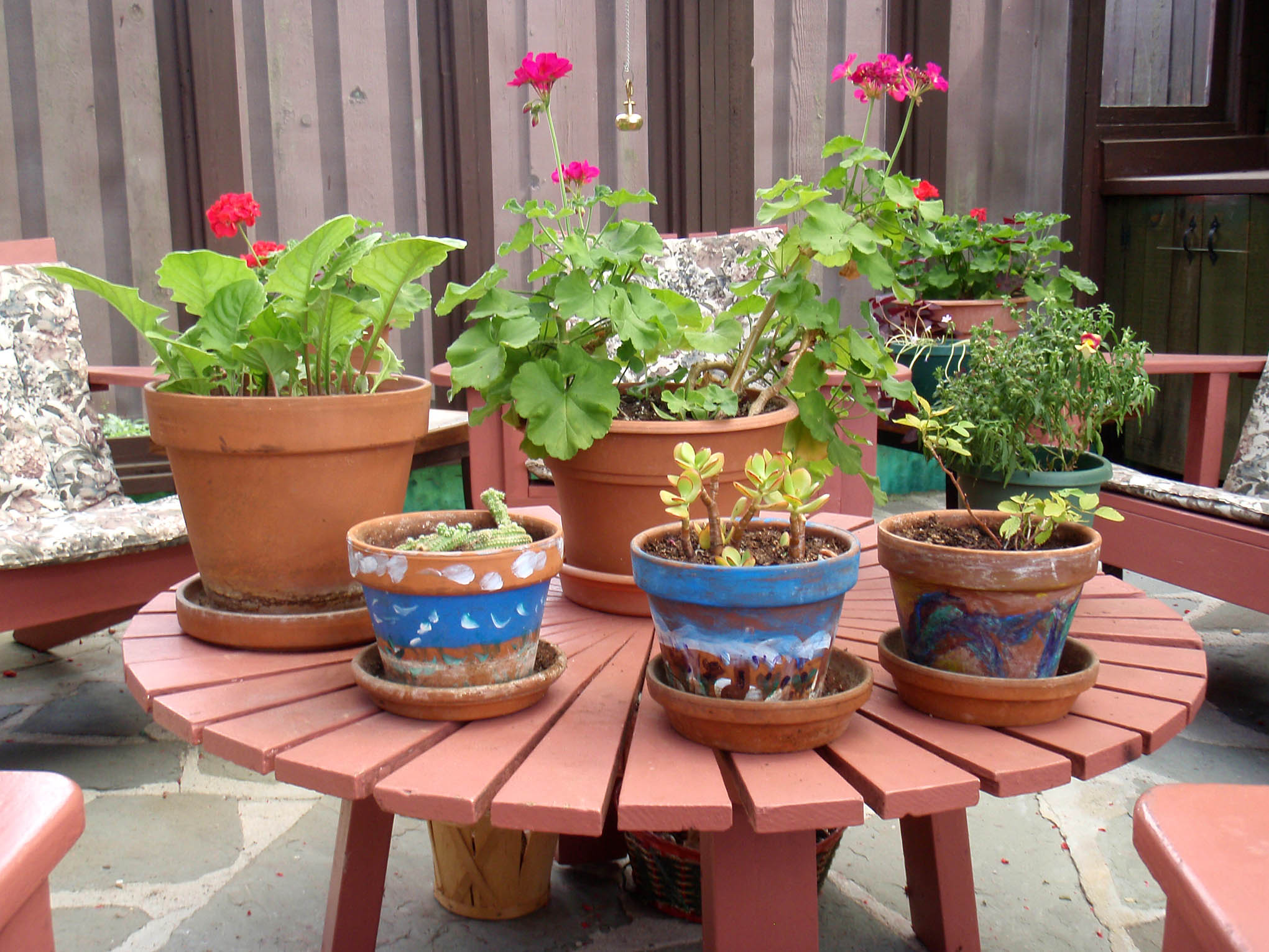
Here’s a picture, not of my Droid, but of my Droid case, taken with the Droid.  This was supposed to be a temporary case.  I didn’t even save the name of the company that made it.  I like it so much now I’m going to keep using it.  It’s colorful, it protects my Droid and it’s made with recycled products, whatever they are.  I brought the plants and the pots they are in from California.

Droid Case with my California Plants, March 2010, Pennsylvania

I love my Droid.

Merry Christmas from My California


Memories of My California, looks like snow.

Limatour Beach at Sunset, Point Reyes National Seashore, California, March 2006

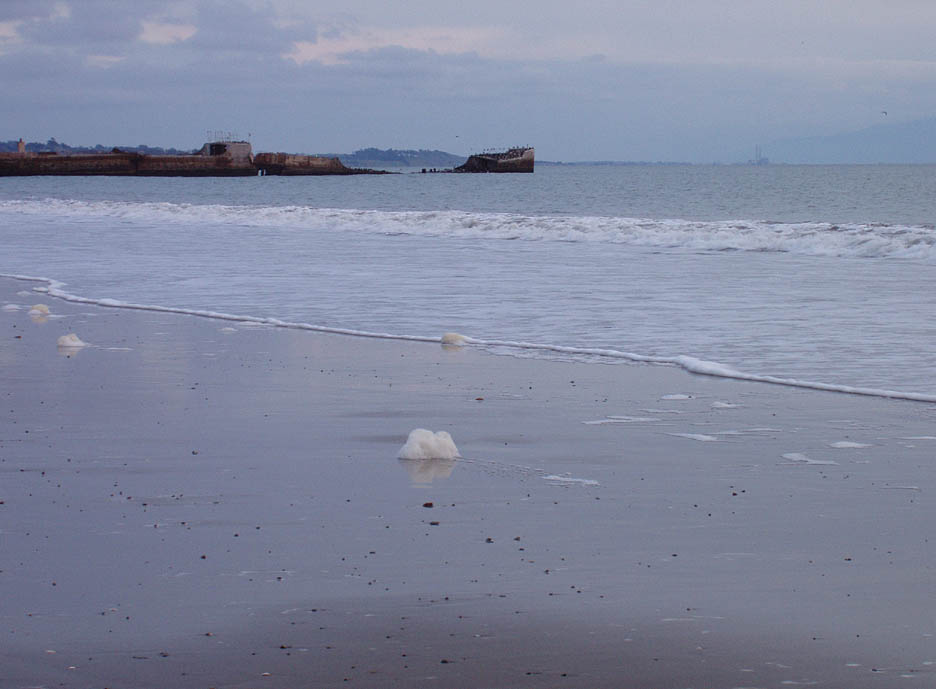
Seacliff State Beach, California, February 2005

My Journey, California to Pennsylvania, July 2009. Part 3 of 3, Missouri to Pennsylvania

In July 2009 (this year) I left my beloved California and moved to Pennsylvania. I wrote about leaving California in my blog post “Leaving My California” – https://amarez.com/2009/07/19/leaving-my-california/

My first travel post describes my journey from California to Sedona – https://amarez.com/2009/12/05/my-journey-california-to-pennsylvania-july-2009-part-1-of-3-from-california-to-sedona/.

My second travel post describes my journey from Santa Fe, New Mexico to Oklahoma – https://amarez.com/2009/12/05/my-journey-california-to-pennsylvania-july-2009-part-2-of-3-santa-fe-to-oklahoma/

After Oklahoma, I drove east to Missouri,  continuing my journey to Pennsylvania.  I’m including my tweets (twitter posts), from that time.

July 26, 2009.   In Joplin, Missouri for the night – currently having dinner at a local place recommended by my motel – just down the street!

July 26, 2009.  So much for SF food snobbery. Grilled tilapia at a place called Whisky Creek, and it’s really really good!

July 27, 2009.  Staying in Rolla, Missouri for two nights. I need a break from driving. The Ozarks are pretty.

Ozarks from Highway near Rolla, Missouri, July 2009


July 28, 2009 .  It rained here in Missouri. I miss the weather in my California – only rains in winter, no thunderstorms, no snow. Not a fan of weather.

On to Illinois.

Water Tower, Casey, Illinois, July 2009


July 29, 2009.    Just west of Indianapolis. I saw fields of corn, being that I’m in the midwest.

July 30, 2009.   Stayed at the Hampton Inn – great rate with AAA and business travel is down so room rates are good. Reminded me fondly of business travel.
Hampton Inn, Plainfield, Indiana, July 2009


July 30, 2009.  In Ohio – not much further to go

The highways got more crowded.  Ohio had great highway rest stops, very nature oriented.  There was  a wonderful wooded area, with picnic tables, at the place where I stopped.

Wooded Area, Highway Rest Stop, Ohio, July 2009


July 31, 2009.  In Pennsylvania – not much further to go

Driving on Highway 70 through  West Virginia (briefly) and western Pennsylvania, the scenery was spectacular,  a winding road,  mountains, trees, very dramatic.  Sadly, I did not get any pictures.

I stayed at a hotel in Bedford, Pennsylvania.  While a bit on the faux “old timey” side, the hotel was confortable and had a certain charm.   The lights in front of the hotel were interesting.  The morning the fog was mysterious.

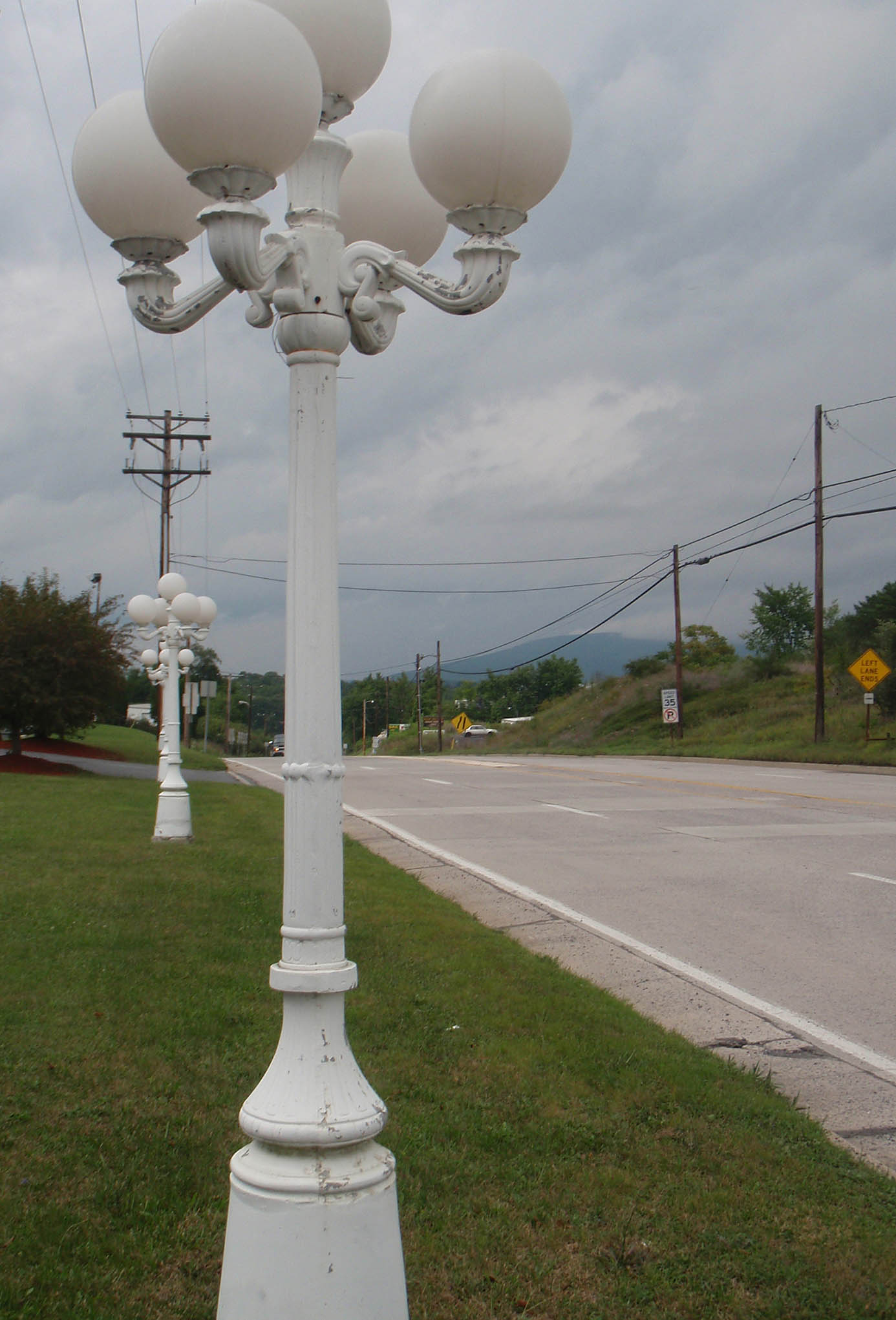
Street Lamps, Bedford, Pennsylvania, July 2009

Morning Fog, Bedford, Pennsylvania, July 2009


Continuing on the Pennsylvania highways.

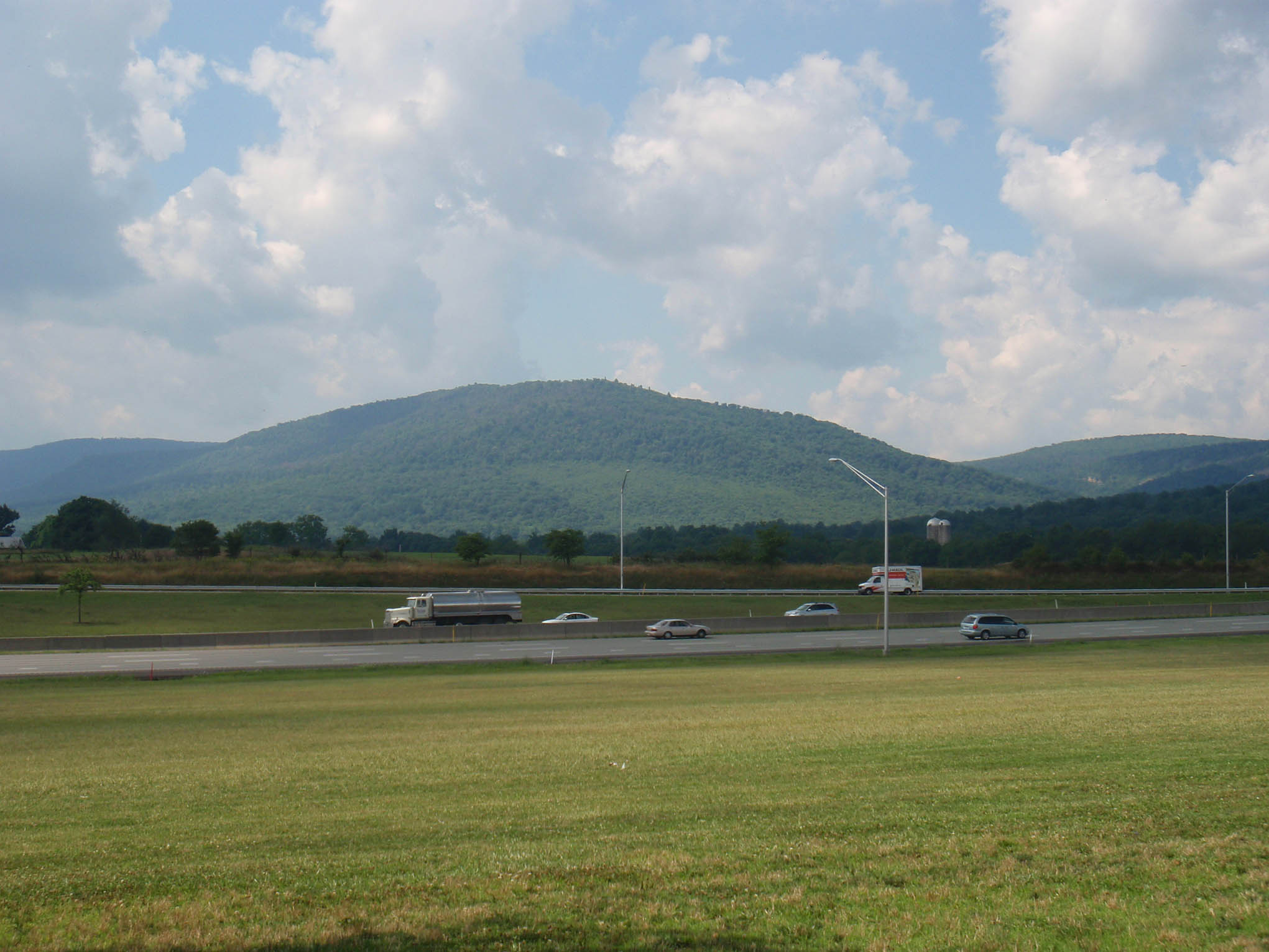
Pennsylvania Highway, July 2009


August 1, 2009.   2900 miles, 13 days and I’ve reached my destination! My road trip is over.

The miles are wrong — I was looking at the wrong thing.  Per google maps, the journey was 3112 miles!

Beautiful Garden, Family Home, Pennsylvania, August 2009

My Four California Plants on the Porch with other Family Plants, Pennsylvania, August 2009


My journey ends.

My Journey, California to Pennsylvania, July 2009. Part 2 of 3, Santa Fe to Oklahoma

In July 2009 (this year) I left my beloved California and moved to Pennsylvania. I wrote about leaving California in my blog post “Leaving My California” – https://amarez.com/2009/07/19/leaving-my-california/

My first travel post describes my journey from California to Sedona –  https://amarez.com/2009/12/05/my-journey-california-to-pennsylvania-july-2009-part-1-of-3-from-california-to-sedona/.  After Sedona, I drove east to Santa Fe, New Mexico, continuing my journey to Pennsylvania.  I’m including my tweets (twitter posts), from that time.

July 22, 2009.   Rolled into Santa Fe several hours ago. Hotel is great. Will explore tomorrow.

July 22, 2009.   Note to self – drive from Sedona to Santa Fe, while spectacular, is rather long.

July 23, 2009.   Santa Fe – having green chili chicken tamales for dinner. Does it get any better than that? Santa Fe is a great place.

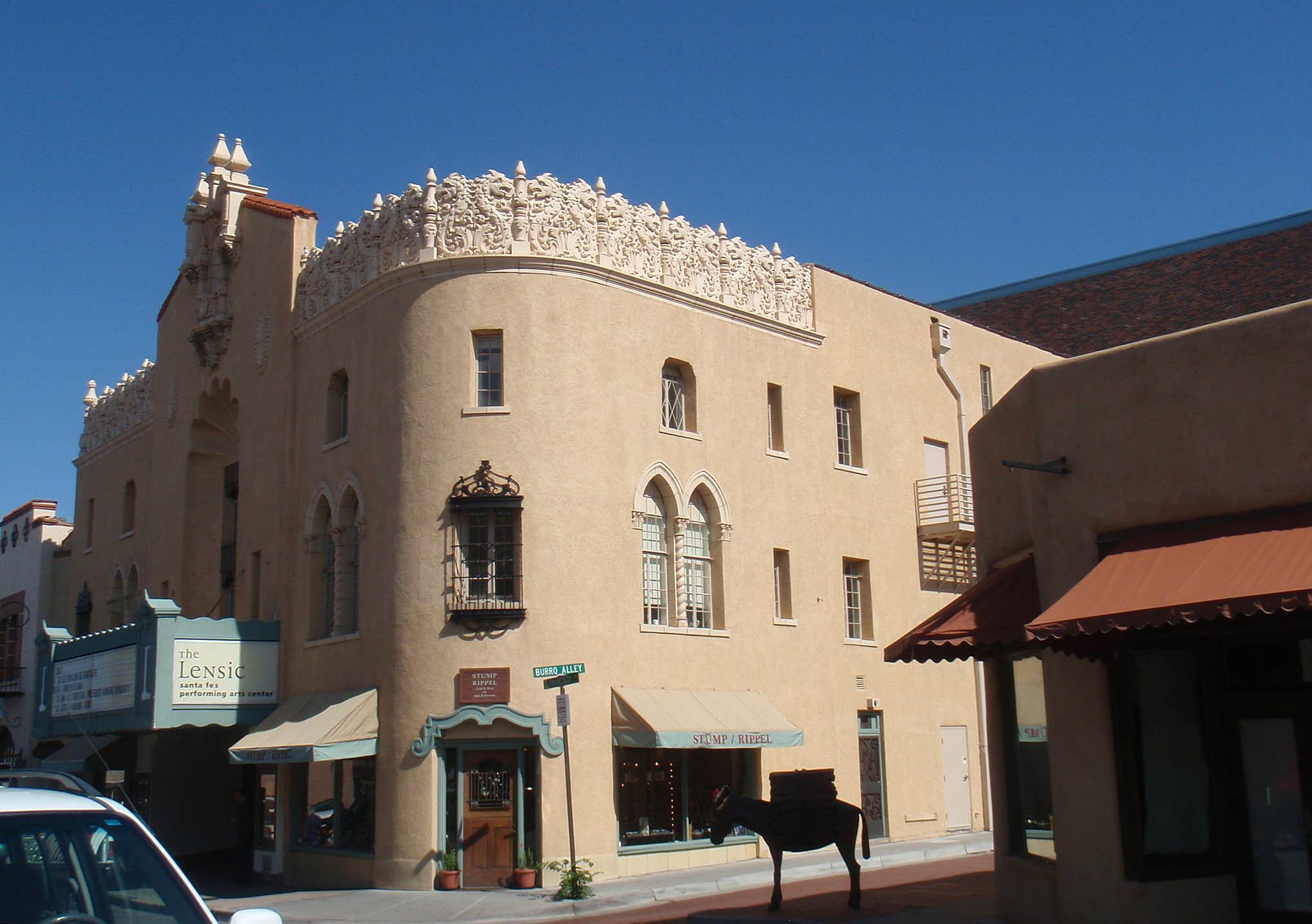
Downtown Santa Fe is small and very walkable.  Given the consistency of the architecture, one is tempted to think it’s too cute, too contrived, but it’s not, really.  Everything seems to fit.  Given the high elevation, it’s very comfortable in summer, though I made sure to drink plenty of water.  It was nice to just wander around.  I want to come back.

San Miguel Church, Santa Fe, New Mexico, July 2009. Oldest Church in the US.

Street Scene, Santa Fe, New Mexico, July 2009. I sat under the umbrella and drank a lemonade.

Street Scene, Santa Fe, New Mexico, July 2009

Tia Sophias, Santa Fe, New Mexico, July 2009. Santa Fe style Mexican breakfasts, incredibly wonderfully good.


After Sedona and Santa Fe, I had no specific places I wanted to see.  I took the most direct highway route northeast.

This is from a highway rest stop, the Llano Estacado, or “Staked Plain”, a large mesa straddling New Mexico and Texas.  A “mesa” is an elevated area of land with a flat top and steep sides (thanks to wikipedia, http://en.wikipedia.org/wiki/Mesa, http://en.wikipedia.org/wiki/Llano_Estacado).  The sense of distance was amazing.

Llano Estacado from Highway Rest Stop, Texas, July 2009


July 24, 2009.   In Amarillo for the night. Listened to a really good alternative music station on the way into town. Swam in the hotel pool.

July 25, 2009.   Light travel day.  I’m in Oklahoma.

July 26, 2009 (posted this tweet after I left Oklahoma).  Favorite highway sign on I44 east – Oklahoma area – do not drive into smoke. What kind of fires do they have in Oklahoma?

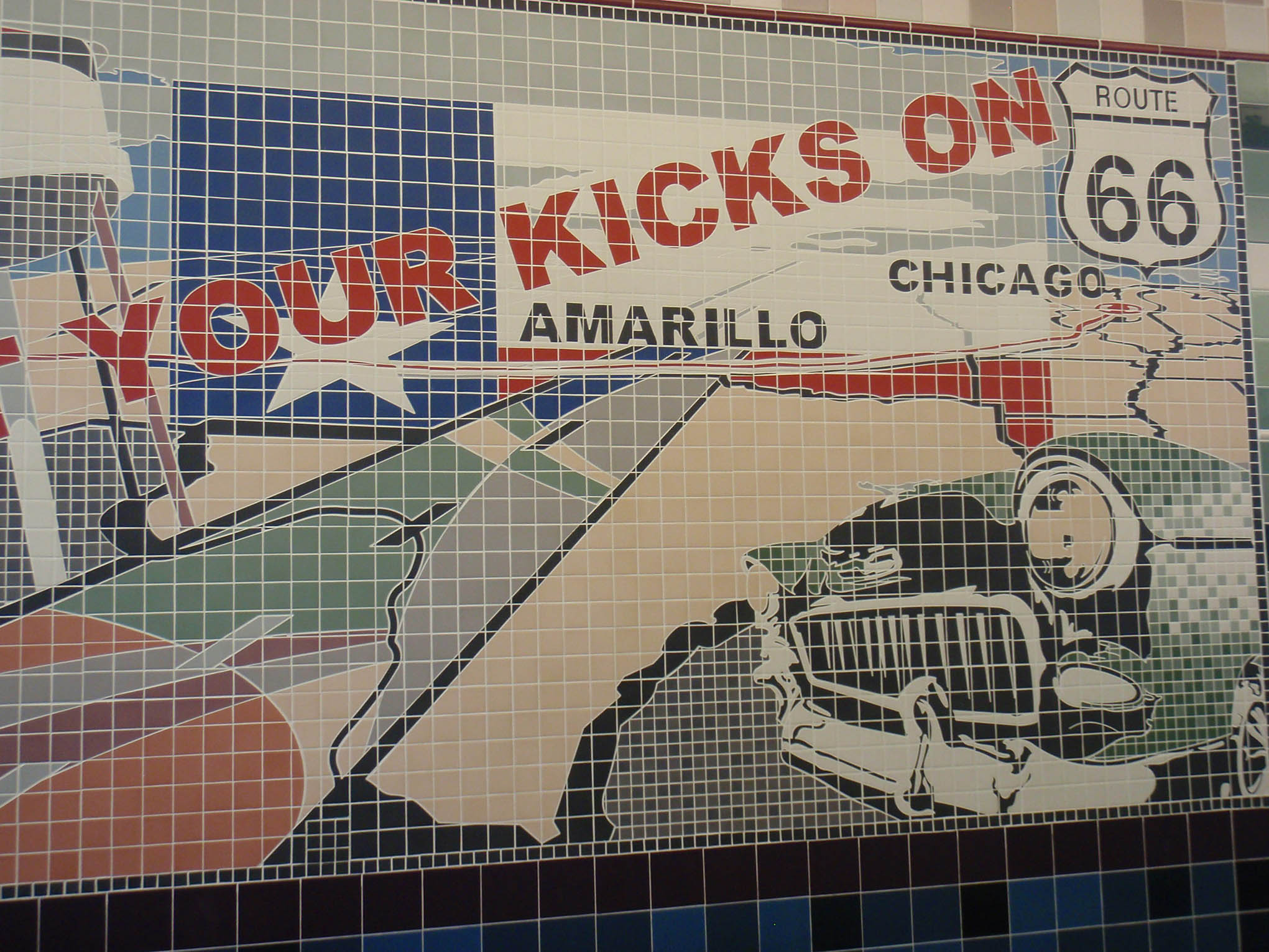
In Oklahoma, I ended up briefly on Route 66, the famous US highway which ran from Chicago to Los Angeles, started in 1926, paving completed in 1938. (http://www.legendsofamerica.com/66-Mainpage.html)   I stopped at a fantastic commemorative rest stop.  You can also see views of the Oklahoma plains.

Route 66 Commemorative Rest Stop, Oklahoma, July 2009

Tile Picture, Route 66 Rest Stop, Oklahoma, July 2009

Oklahoma Plains


In my next blog post, I head on to Missouri.

My Journey, California to Pennsylvania, July 2009. Part 1 of 3, from California to Sedona

In July 2009 (this year) I left my beloved California and moved to Pennsylvania.  I wrote about leaving California in my blog post “Leaving My California” – https://amarez.com/2009/07/19/leaving-my-california/

I drove across country, from California to Pennsylvania, keeping people updated (mostly) via twitter.  Thinking about what I wanted to see the most, I picked Sedona, Arizona and Santa Fe, New Mexico.  So, south from Palo Alto on Highway I5, stopping off at Gorman, California, as I always stop there on my way to Santa Monica.  Then, east through the desert to Sedona, Arizona, east again to Santa Fe, New Mexico, and northest to Pennsylvania.   I’m not a long distance drive and I stopped for two days, twice.  So, around 3000 miles, in 13 days.  Here’s the journey.  I’ll include my tweets — twitter posts.

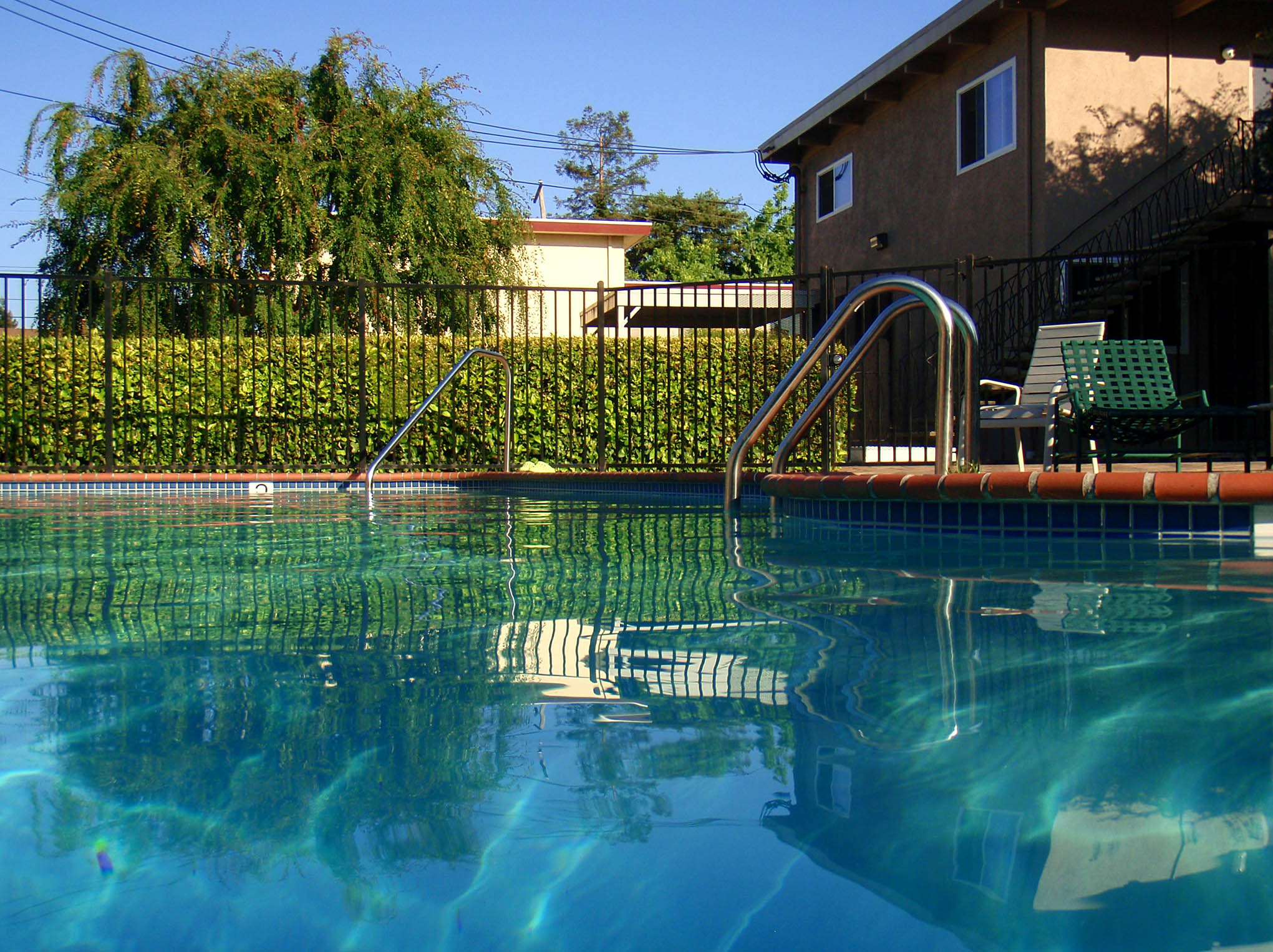
My Apartment Pool, Palo Alto, California. I loved this pool.

Courtyard of my apartment complex in Palo Alto. I could not take the two trees I was growing, in pots.

Some plants from my container garden. Four plants made the journey with me.


Google Map of My Tip, July 2009


July 20, 2009.  I5 to Gorman, California. Very hot. Econo Lodge kept the chandelier from the former Caravanseri Motel!   

Econo Lodge Hotel, Gorman, California, July 2009. They kept the chandelier from the Caravanseri Motel.


Drove east through the Mojave Desert, on to Arizona, highway through the desert.  Lots of space.  It was very hot.  The Mojave desert had a stark beauty.  Continued on through the Arizona desert, which was beautiful.

Mojave Desert from the Highway Rest Stop, California, July 2009

Arizona Desert, West of Sedona, July 2009


July 21 , 2009. From what I’ve seen in the dark, Sedona looks like all kinds of wonderful, my kind of place.

July 21, 2009. Looking forward to actually seeing the red rocks of Sedona, tomorrow, as I head out of town.

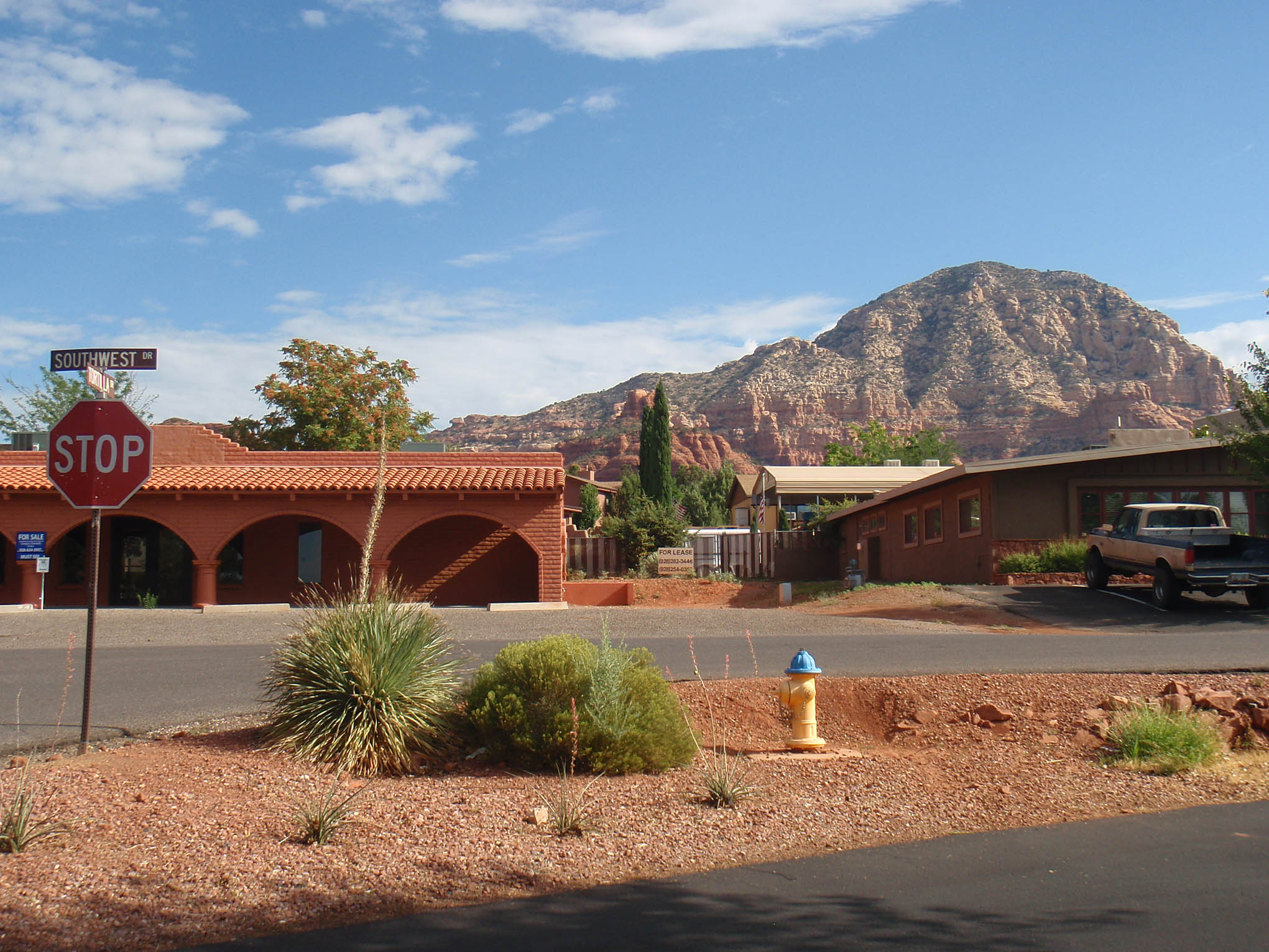
July 22, 2009.  Eating breakfast (huevos rancheros, yum) at a cute place down the street. The red rocks of Sedona are everywhere – dramatic, beautiful.

View of Red Rocks, Sedona, Arizona, July 2009

Tile Picture, Kaiser's West Restaurant, Sedona, Arizona, July 2009. Great Breakfasts

View of Red Rocks of Sedona as I Leave Town, Sedona, Arizona, July, 2009


Next Blog Entry, Santa Fe, New Mexico, and east.

Interop 2009, Web 2.0 2009, New York City

On November 18th and 19th I went with a family member to New York City to attend Interop 2009 New York (http://www.interop.com/newyork/) and Web 2.0 New York (http://www.web2expo.com/webexny2009).  We stayed at one of the conference hotels, the Wyndham Garden Hotel Times Square South, Hotel, in the garment district of Manhattan (http://www.wyndham.com/hotels/NYCMT/main.wnt).  It was a short walk to the convention center.

I’m not fond of New York City, which I describe as “Gotham City and not in a good way”!  I don’t like the concrete canyons and the crush of people.  This time I really enjoyed myself.  I loved the hotel.  I liked my block in the garment district.  I liked the walk to the convention center and the wonderful Thai restaurant across from the hotel, Royal Thai Cuisine II (http://www.royalthainyc.com).  We saw a Broadway play, The Thirty Nine Steps (http://www.39stepsonbroadway.com/) and that was wonderful. I had a great time at both conventions.  I had a great travel companion.

I had expo passes to Interop and Web 2.0, which gave me access to the keynote speaker presentations, selected conference talks and the expo floor.

Interop is about business computer “stuff”, hardware, software, networks.  It’s targeted to the IT professional who has the authority to make decisions on the technical architecture and products for their company.  Web 2.0 is about “the web”, with a more inclusive definition of web stuff.  Think of the web as being at the center of what you do on the computer, both personally and professionally.  Web 2.0 is also about collaboration, social networks, updating information on the web in “real time”.  I think the term “Web 2.0” is also used to differentiate between companies that failed during the “dot com” bust, and companies still in existence doing web stuff, but that’s a personal opinion.

“Compare and Contrast” follows.

Keynote Presentations:  polished and professional, both at Interop and Web 2.0.  Interop had one main theme, cloud computing.  Web 2.0 had no overall theme.  The Interop presenters were senior executives at tech companies and other institutions.  The Web 2.0 presenters were a more varied group, writers, comedians, publishers, researchers, government types.  Interop did have one tech columnist, David Pogue, who was really good.

The presentations were all good, though the Interop presentations were consistently more compelling.  I think that’s because the world has changed.  Senior executives at big tech companies – they really know how to present.  Along with knowing their stuff, and wanting to sell it to you, it’s a media job.  Web 2.0 had more “talking heads” kinds of presentations (some funny ones too), also less polished slide content.  There were some gems at Web 2.0.  One of the most interesting presenters at Web 2.0 was Gentry Underwood from the famous design firm IDEO.  Gentry talked about designing for the web.

Focus:  Interop is focused on what I would call “things”, big things – electronic pieces of equipment, and the stuff to run them.  Web 2.0 is focused on communication.  This carried over to the personal space.  The fun presenter at Interop was David Pogue, who talked about and gave demos of fun applications for the iPhone, a piece of equipment, a thing.

Naivety:  Web 2.0 had the idea that, somehow, a speech, even a speech in front of 2000 people, was a collaborative event.  At the keynote presentations a background screen behind each speaker displayed live tweets about the presentation from the audience, displayed during the presentation, real time.  (Tweets are electronic posts over the internet, using Twitter).  The tweet screens were distracting and annoying, and of course it went bad.  At a presentation I did not attend, the tweets become personal and disruptive.  At the presentations I went to, the day after the bad incident, the tweets were displayed behind the speakers, but the tweet stream was moderated, with a small time delay.  I thought the whole concept of a live commentary was naïve, also a misrepresentation of what it means to give a talk in front of thousands of people.  The keynotes were speeches at a conference, not a dialogue, even if people felt compelled to talk about it, electronically, as it was happening.  Electronic forums have their own challenges; when unmoderated, they almost always become antagonistic and disruptive.  There’s also the “class clown” syndrome.  It’s human nature for people to try to get attention.  Given an opportunity, one person will try to outdo the other.  Generally, at a conference, you set up a presentation to maximize people paying attention, given the distractibility of convention goers.  At Interop there was no attempt to make the presentations “collaborative”.  For one thing, no Interop presenter would agree to such a disruptive element.  I found the straightforward attitude at Interop refreshing.  The attitude of the conference and presenters appeared to be “I’ll do the best job possible presenting, and I hope you’ll listen”.

The Expo Booths:  Web 2.0 and Interop shared the same exhibit space, Web 2.0 on one end, Interop on the other.  This was good for companies that wanted to address both audiences, such as Microsoft and IBM.

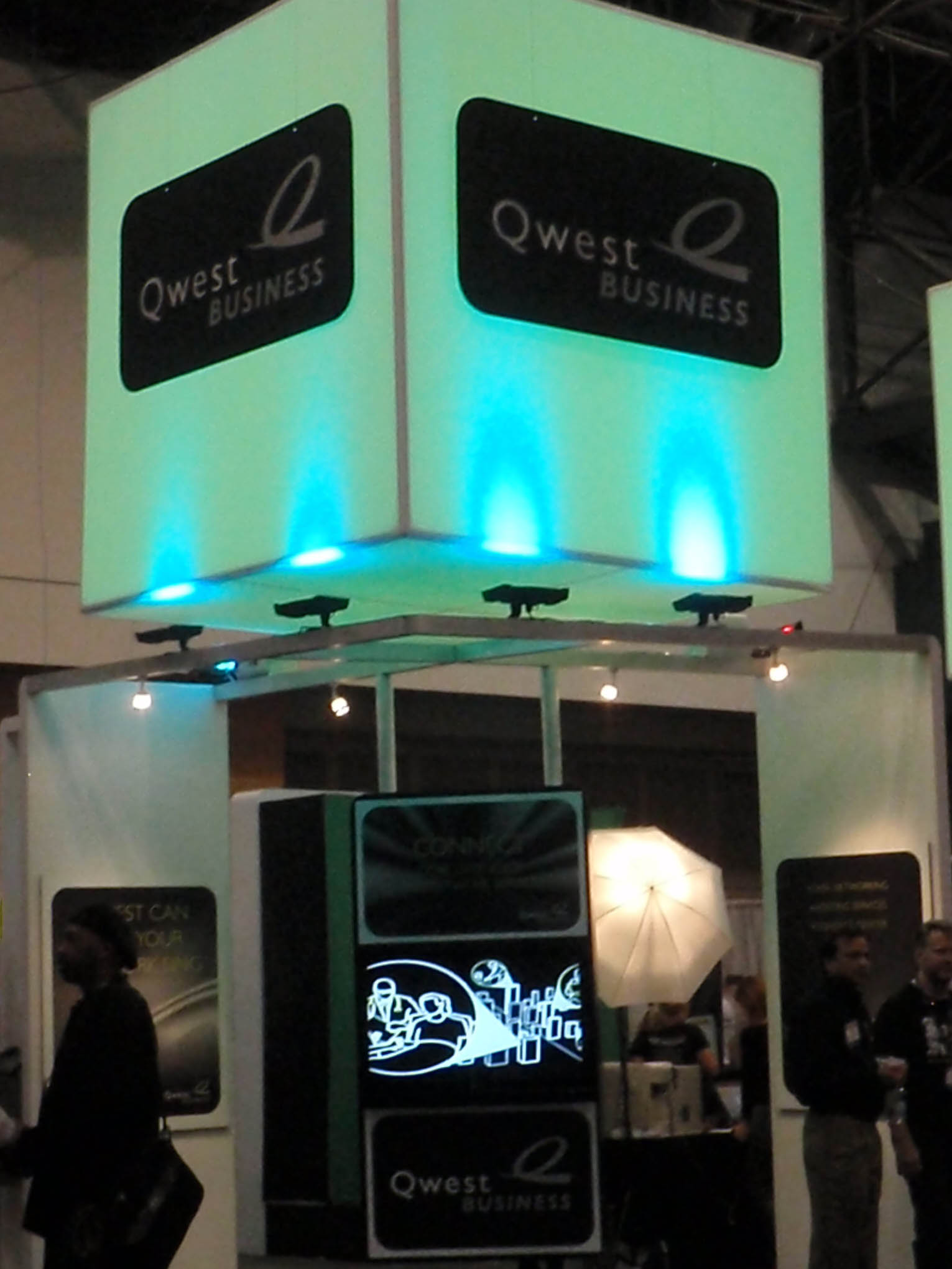
Expo booths are designed to display products and get you interested in buying the product.  At the tech conventions I’ve been to, I’ve found the booths to be colorful and well designed.  Both Interop and Web 2.0 had good booths, but the booths at Interop were better, better as in more dramatic, eye catching, bigger, with better free stuff.  The best booth was the booth for Qwest – http://www.qwest.com/business, a telecommunications company.  Advertising their “rock solid network”, you could get your picture taken as a rock star.  Qwest had all the requisite props to make you look like a rock star – tattoo sleeves, guitars, mikes, hats, dark glasses, feather boas (think 70s rock).  It was so much fun.

Why the difference?  I think the difference is due to the audience and the products.  Exhibitors at both conferences were showing their products so you’d get interested in their products and spend money, but there are differences in the nature of the products and the participants. Citrix, who had a booth at Interop, can sell you something small, but they really want to sell you big stuff, in terms of price and breadth — big computers (servers), virtualization software for your whole company.  So, they make a booth that looks like a spaceship.

I’ll conclude with some pictures:

Javits Convention Center, New York City, 2009. I like the space.

Citrix Booth, Interop 2009, New York City. Looks like a spaceship.

Expo Floor, Interop 2009, New York City

Qwest Booth, Interop 2009, New York City. We got to be rock stars!

Interop 2009, Keynote Stage, New York City

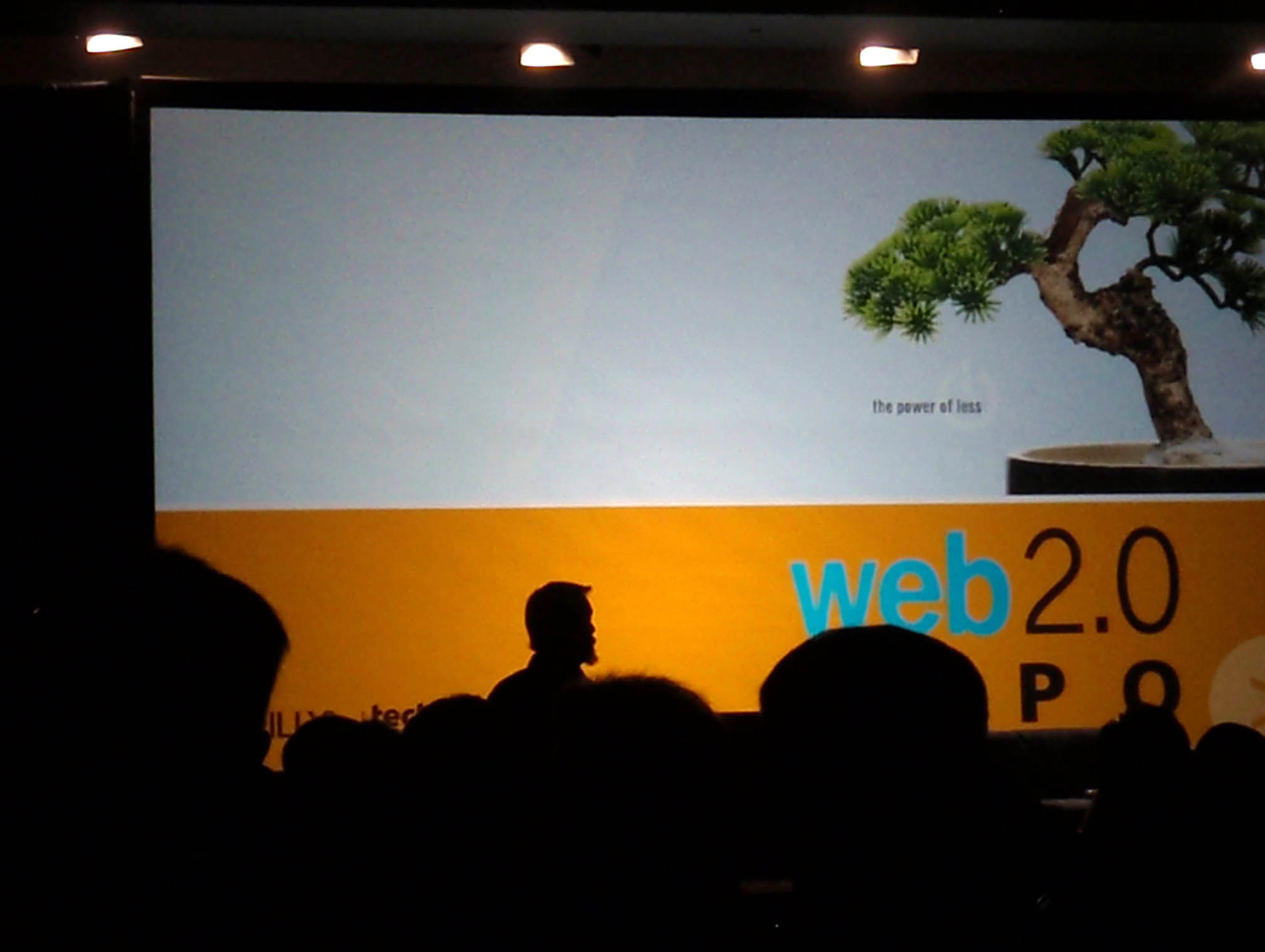
Web 2.0 2009, Keynote Stage, New York City

Wyndham Garden Hotel Times Square South, New York City, November 2009

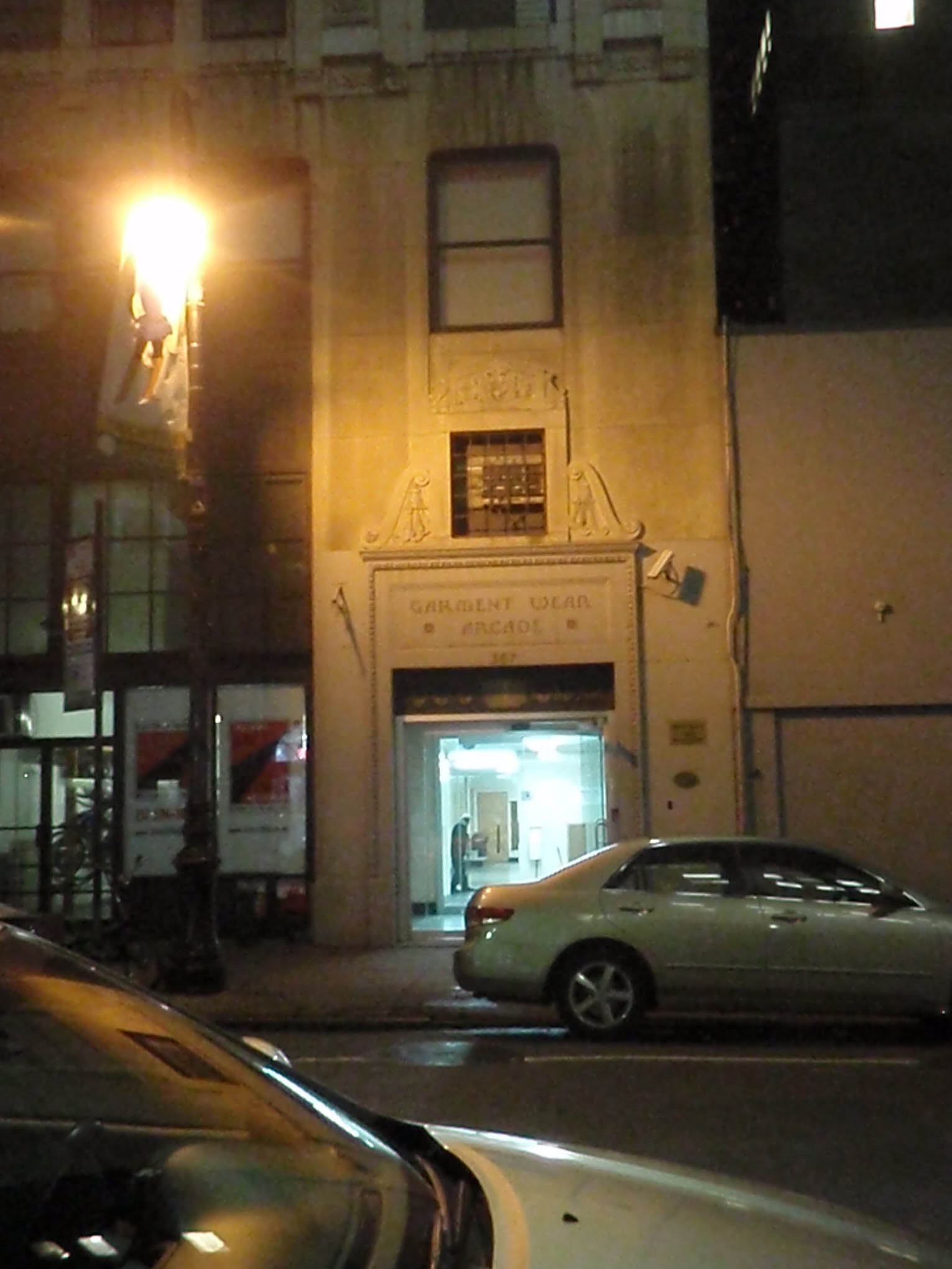
Building, Garment District, Manhattan, New York City, November 2009

Farmville – Fantasy Farming, a Spaceship, a Picture, Issues

Farmville — a fun casual simulation game, played in your browser via Facebook. The look of the game is a bit cartoony, but it’s pretty and appealing. Your goal is to build and manage a farm — couple of clicks, nothing hard. You grow crops and trees and keep animals. When you harvest the fruit trees, the crops, collect eggs (all with a click on the item) you get money to expand your farm.  “Farm” is loosely defined. My “farm” has a crashed alien spaceship, green cows (think spaceship radiation), a Ferris wheel, a variety of farm animals, some reindeer, nine small plots of land, a citrus orchard, and more. On the animals — you do collect eggs, but that’s as far as it goes. There’s no animal killing.  When your pigs are ready to produce something, they give you truffles!

What makes Farmville manageable is that time progresses when you aren’t there, and what you do in the game is limited.  If a crop is ready to harvest in two days, it’s two calendar days.  Farmville is a nice complement to Facebook. The social aspect happens when your Facebook friends give you Farmville “gifts” (trees, sheep, etc), and when you go help out on your friends farms — simple clicking to get rid of weeds, all that. Advancement is based on two things, making money, and gaining XP, experience. As you progress in experience, you unlock more levels and can buy more stuff.

The trick in playing Farmville is to limit the amount of things you pay for, using real money.  The game is free to play, but there are some things that take a long time to acquire, and some things that can only be bought with real money. Zynga, the developer, is an expert at the microtransaction business — getting you to pay for stuff. You can have a perfectly great time without microtransactions, but it’s hard to resist, since the extras are very appealing. I have not completely resisted — I really had to buy that spaceship and the Ferris wheel! Farmville also has seasonal items, some of which you can buy with cash you earn in game, while some, as far as I can tell, requires spending a little “real” money.

Zynga, the developer, structures it so that, if you let it, you end up automatically posting your progress on Facebook, a lot.  That’s the whole point — it’s social and it’s also an advertisement for the game. The posting is optional. I tend to limit what I let Farmville post on Facebook. Unless your Facebook friends are only there to play Farmville, they will get tired of seeing all your Farmville posts, if you let Farmville post every one of your accomplishment.

Most of my Facebook friends do not play Farmville, but enough do so that I have Farmville “neighbors”. I like it. It’s also a fun way to reconnect with people you haven’t seen in years, people who would never play any other kind of video game.

As for the company itself, Zynga is the darling of the business world — their casual browser based games bring in money.  Unfortunately, Zynga does have questionable business practices. There are a several articles about their practices.  The Wikipedia article isn’t too bad. Techcrunch also has some good articles. Here’s an interesting article —

http://www.techcrunch.com/2009/10/31/scamville-the-social-gaming-ecosystem-of-hell/.

The issue isn’t paying for extra items — that’s all up front, nothing wrong about that. The issue is in getting your Farmville “cash” for things you need for Farmville, Mafia Wars, Fishville, or other games via lead generation practices. As long as you stay away from signing up for questionable services, Farmville is fun and safe to play.  To give he Facebook people credit, they’ve been responding to the issues.

Getting back to the fun of Farmville, here’s a picture of my farm.  I’m trying for the European villa look, but I got distracted by the Roswell specials, as well as the festival specials.  I like the look of my orchard, which rings the farm.  I like my big pond and my little pond.  I like the science fiction touch. It’s a fantasy farm, so all my animals roam freely, and there’s no mess and no predators.  Even the cats are nice to the other animals in my Farmville fantasy!

My Farmville Farm, December 1, 2009

In the Land of the Cute

I take walks in the small Pennsylvania town where I’m currently living. I’ve noticed that this town has something I had not seen in years, little figures, lawn ornaments, nestled on people’s property, on their lawns, in their gardens, on a step. The figures are positioned so they can be seen from the street. The intent, I believe, is to be charming, sometimes cute. You do get the cuteness, but you also get effects that are sometimes strange.

These are my favorite pieces. I describe the piece and then show you the picture.

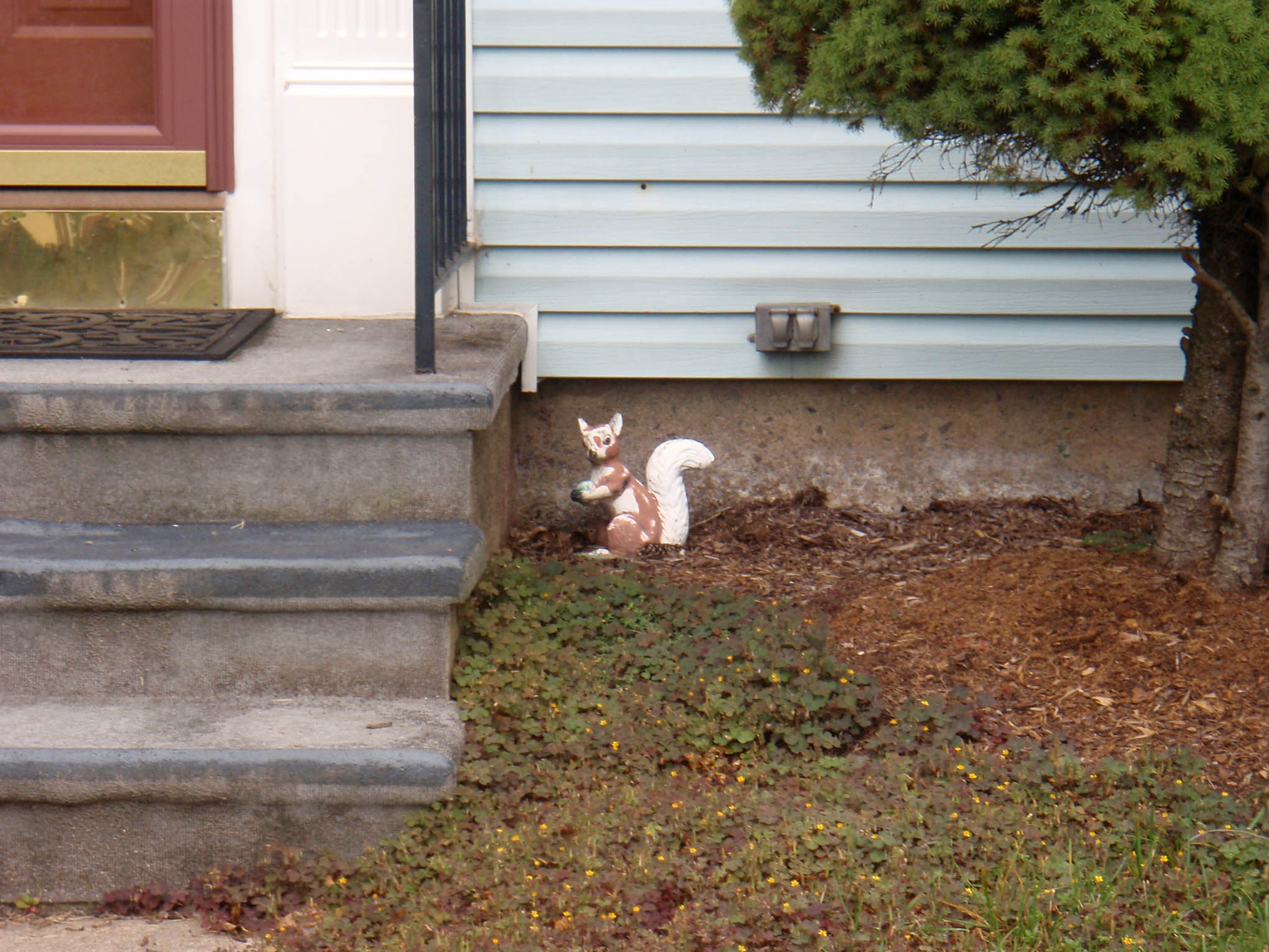
This is an assertively perky figure, all bushy tail, alert posture, slightly startled pose. It’s also very worn and needs paint. The combination make the figure somewhat unsettling, as if the creature was trying to keep up that perkiness, no matter what the cost. I thought it was more interesting to see the figure from a distance, so I didn’t zoom in.

Squirrel, Pennsylvania, October 2009


This is one of my favorite pieces. I like the look of the angel, the lines, the sweep of the wings, the angle of the folded hands. The tipped flower pot nicely frames the angel. The shape of the plant complements the shape of the angel. The green and white colors provide a nice contrast. But you have to ask yourself, who is the angel praying to?

Praying Angel, Pennsylvania, September 2009


This little bunny is worn, but still cute, in a genuinely nice way. I think it works well in the space.

Rabbit, Pennsylvania, October 2009


I thought that I would see more figures in birdbaths and water fountains, but this is the only birdbath sculpture I found on my walks. This work is on the sweet side, and appears to be influenced by Disney, though it’s nicely done. The fairy is easier to see if you click to get the big picture.

Fairy and Frog, Pennsylvania, August 2009


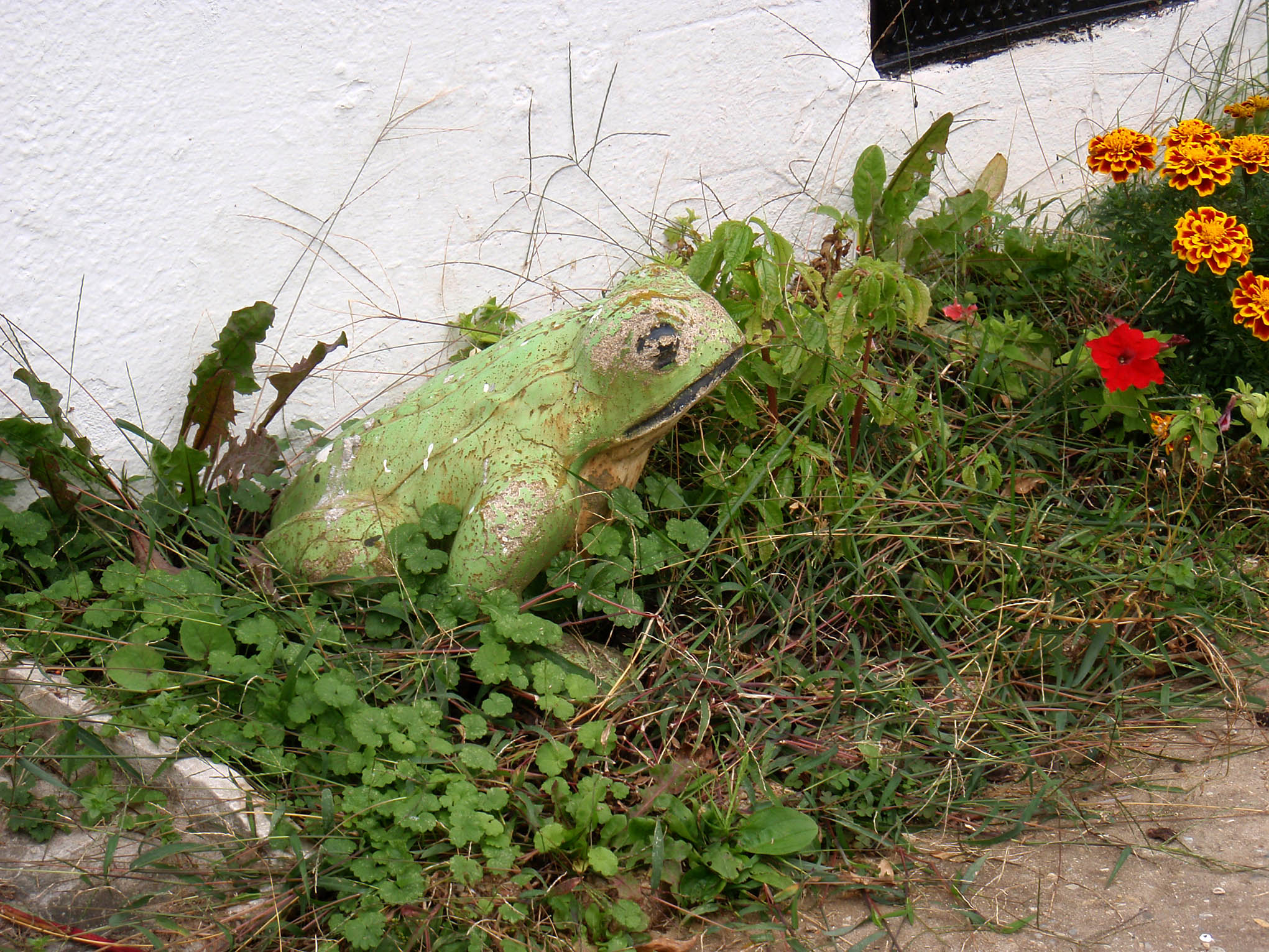
The frog is chipped and needs some paint, giving it a “don’t mess with me, I’ve been around” look. This is a scary frog.

Frog, Pennsylvania, October 2009


Although this picture is flawed, I wanted to include it. I think the frog, though hard to see in this photo, works very well in the space. The frog is a little scary looking, but not as scary looking as the other frog.

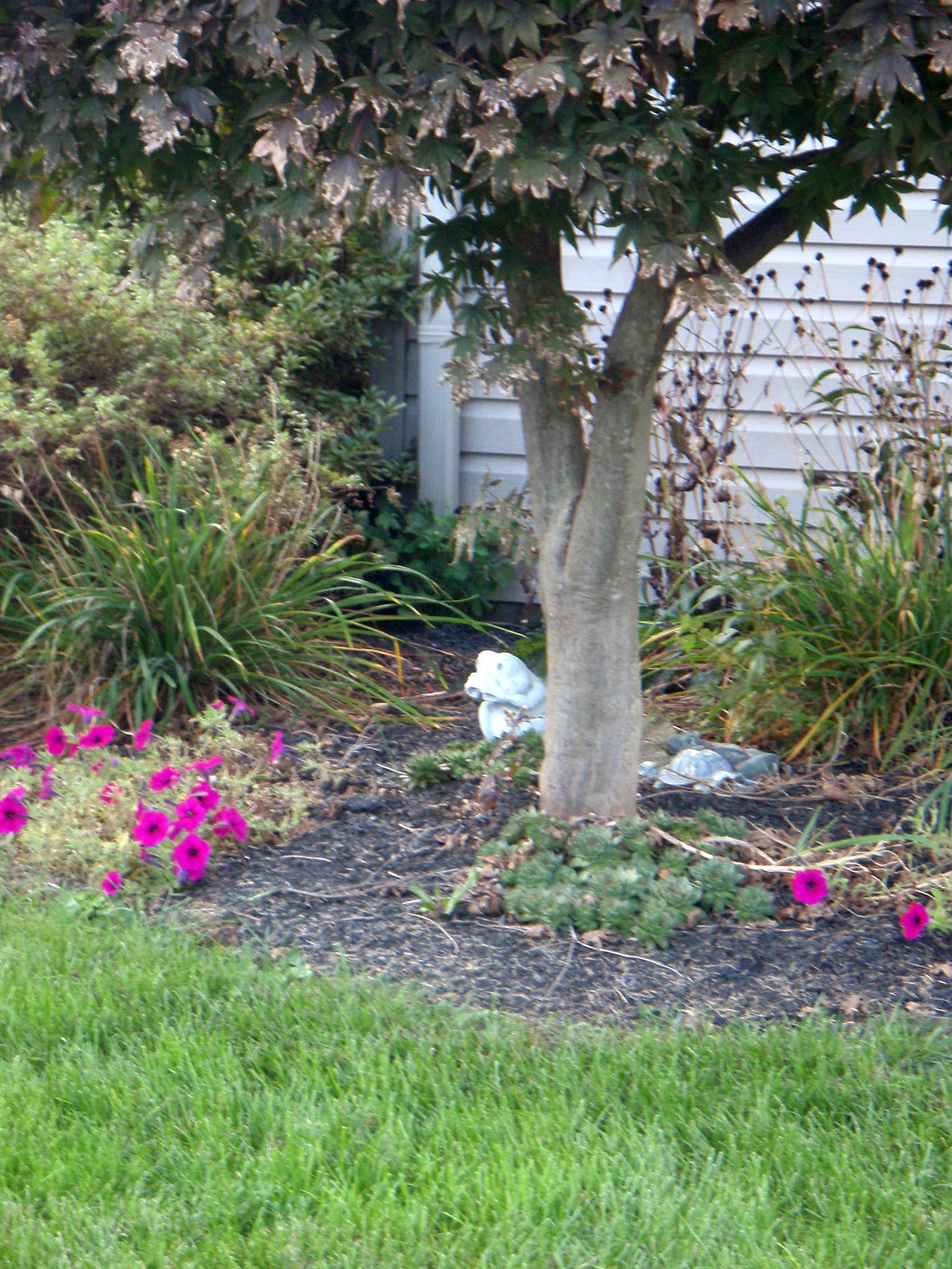
Frog under a Tree, Pennsylvania, October 2009


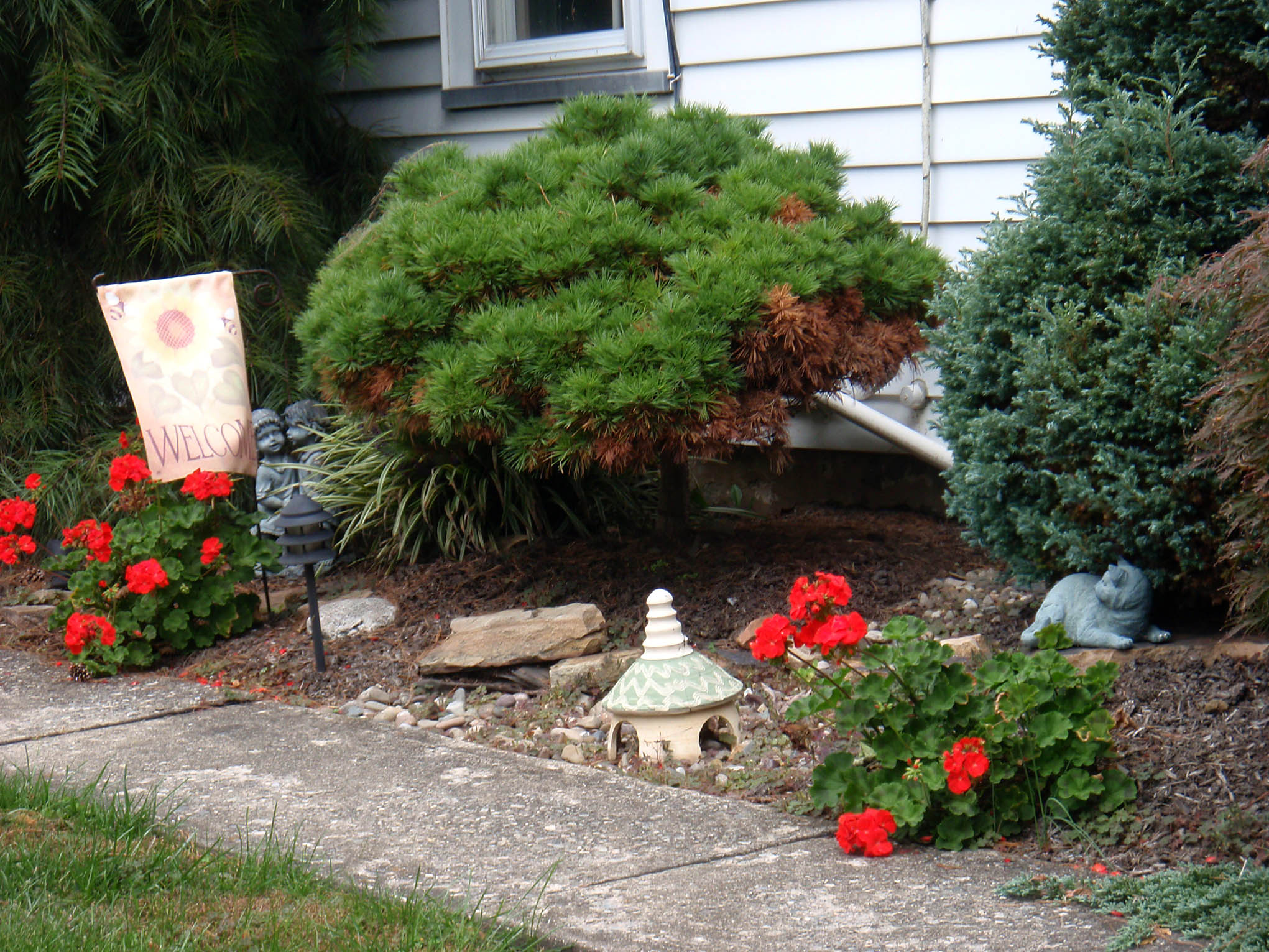
There’s a lot going on here. We’ve got a kitty, a little house, a flag, a bent tree, and two people (elves?) clasping each other. While somewhat odd, even for the Land of the Cute, it has its own charm.

Kitty, surrounded by many things, October 2009


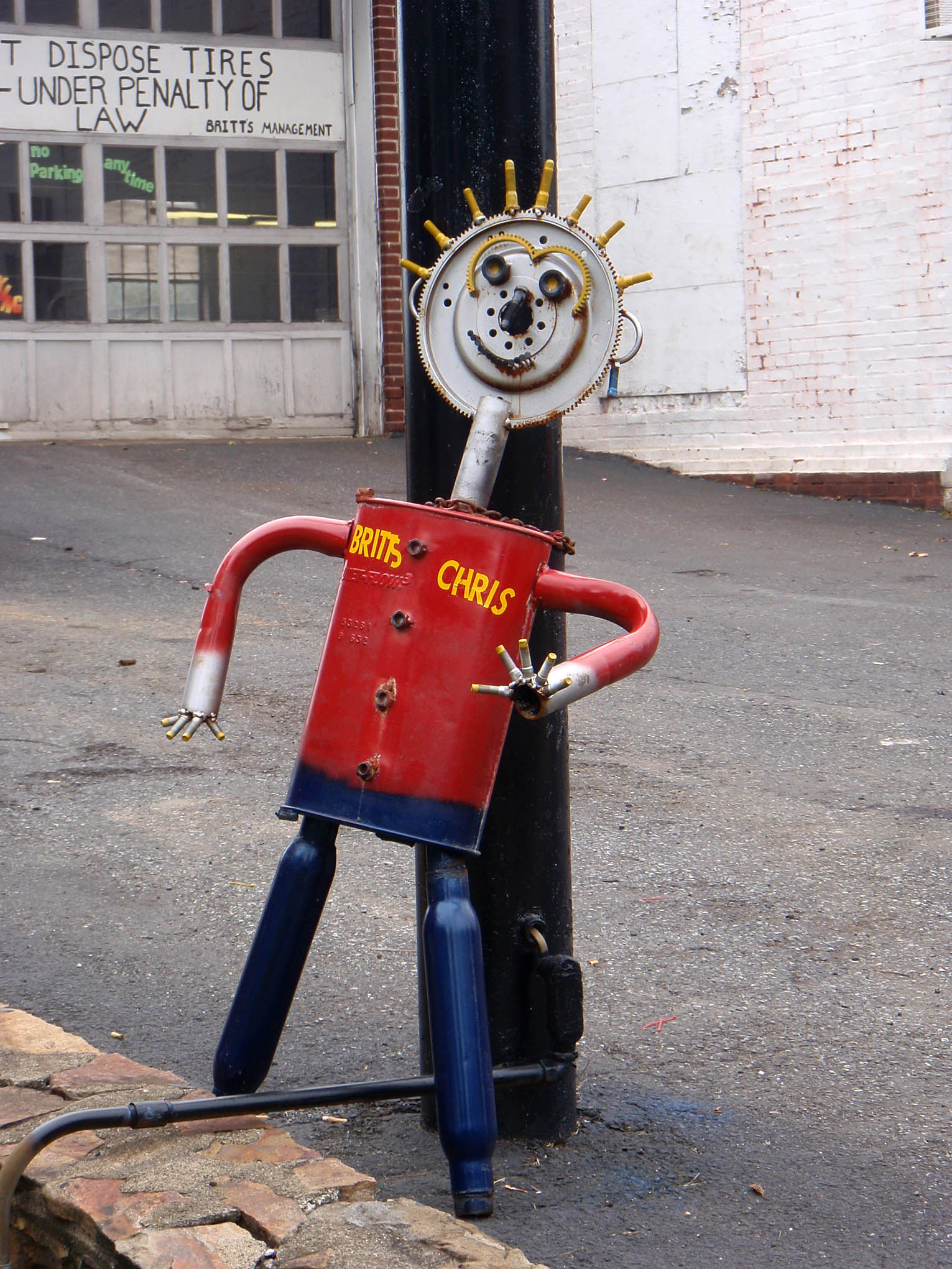
This is an advertisement for a garage. It’s a wonderful piece, perhaps crafted by the owner, funny and engaging. It’s more a work of folk art than a lawn ornament.

Person sculpture, advertising a garage, Pennsylvania, October 2009


Lest you think there is no such thing as an animal sculpture in an outdoor space that isn’t “cute”, look at this wonderful frog sculpture in Rittenhouse Square, Center City, Philadelphia. There’s something interesting and wonderful about the size, shape and look of that frog. This frog is not a resident in the Land of the Cute.

Frog Sculpture, Rittenhouse Square, Philadelphia, November 2009

On being optimistic, tech, the quality of the light, good weather

I had lunch with a friend from high school, someone I had not talked to in years, except for a few brief words when I was back in town visiting my family. We ended up talking about whether we were optimistic about the future.


The economy is in terrible shape, jobs are hard to get if you don’t have one, and there’s a lot of scary stuff in the world. Even though my situation is less stable than before (looking for work will do that to you) – I realized that I am somewhat optimistic about the future – not as optimistic as some people I know (Hi Miki!) but reasonably optimistic. I see the same world as other people, but I think that my life, and the lives of the people around me, even the economy, will get better. I kind of see the glass as half full rather than half empty.

This isn’t a discussion about whether this is a correct or incorrect view, but in how we see the world. Sometimes I think that being optimistic has to do with the fields we are in, the work we do. Working for a tech company (like I did in the past) – it makes you optimistic.

There’s something about being in the tech world that makes you think that the future is full of possibilities, and you can do your part to figure it all out. Not only will you be happy, but, whatever you are working on, it’s going to make the world a better place, and even the non glamorous tech stuff is just so darn great! For some idea of what this is like, read the latest copy of PC World, quickly. Skim through it. Focus on the mood, the vibe, the feeling. Even when the writers at PC World are, understandably, complaining about the latest tech thing that isn’t working, you get the feeling that tech is swell! Tech is swell, and so the rest of the world must be swell too, because tech is in it! There’s a sense of optimism, a belief that the world is a good place.

Sometimes you see this happening in B-School – MBA land, though less often, recently. Perhaps it has to do with the idea of control, that you can do something to make things better and you can make a good living too. I enjoy the belief that you can make things good in the world and not suffer.

Then there’s the quality of the light, and good weather. In my admittedly limited experience the people from my life in California were more optimistic than not about the future. Since tech (and at the time a better economy) is threaded all through my time in California, I can’t separate out the tech optimism and the better economy from the optimism that comes with the wonderfulness of California. I like to think that being in the land of amazing natural light, low humidity, outdoor natural beauty and outdoor comfort – it makes you a happier and more optimistic person. I like to think that the Pacific Ocean and a Mediterranean climate make a person happy. I have absolutely no idea if this is so. Perhaps I would like it to be so, or perhaps that’s just how it was with me. California brought me a life of promise and a life of wonder, though of course there was also the not great stuff that we all have in our lives. You can read my blog post to see what I thought about California – https://amarez.com/2009/07/19/leaving-my-california/

The challenge is to keep that wonder and promise in my new life, not because it’s good or right, but because I want to do so. Can I still feel wonder and promise while living in eastern Pennsylvania (for now, might end up in New Jersey or Delaware). I think so. We’ll see.

Here are some photos on the quality of light.

A sparkling creek in Pennsylvania, near where I live now.   What an interesting reflection.


Creek, Pennsylvania, September 2009

Creek, Pennsylvania, September 2009


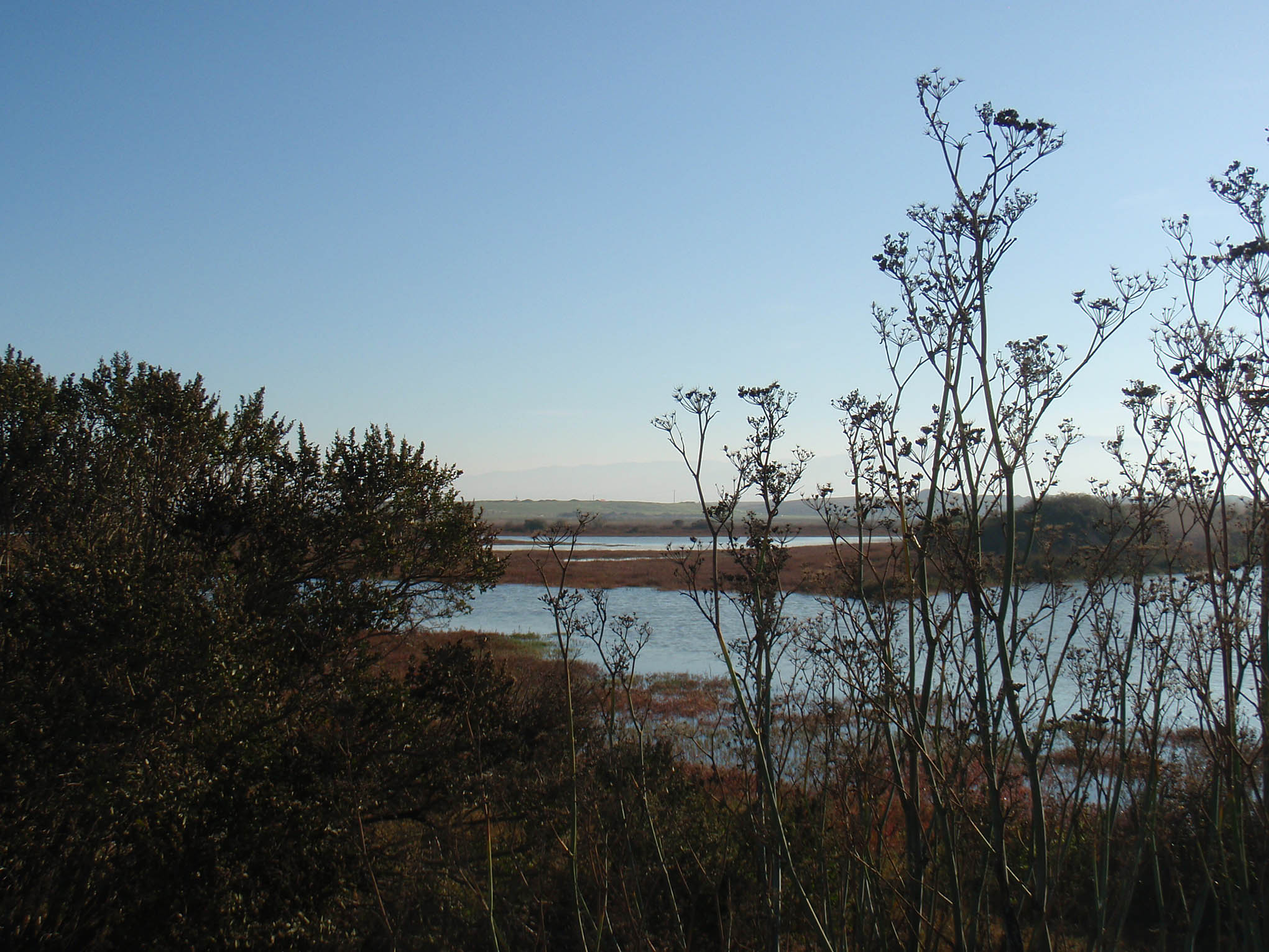
Sunset in the Palo Alto Baylands.  

Palo Alto Baylands, California, November 2008

Palo Alto Baylands, California, November 2008


Went for the day to Ocean City, New Jersey, with a family member. I love the ocean!

Seagulls at Ocean City, New Jersey, September 2009

Seagulls at Ocean City, New Jersey, September 2009

It doesn’t get any better than this – Slate Magazine’s Interactive Dan Brown Plot Generator

Here you go –

The interactive Dan Brown plot generator, By Chris Wilson, Slate Magazine – http://www.slate.com/id/2228327/


I picked the city of Los Angeles and the group Sierra Club. (Note: be sure to click the refresh button as there can be more than one plot for each selection!)

This is what I got:

A mysterious cipher whose key is somewhere in Los Angeles.
A shadowy cult determined to protect it.
A frantic race to uncover the Sierra Club’s darkest secret.

The Forgotten Temple

When celebrated Harvard symbologist Robert Langdon is summoned to the Santa Monica boardwalk to analyze a mysterious rune—imprinted on a gold ring lying next to the mangled body of the head docent—he discovers evidence of the unthinkable: the resurgence of the ancient cult of the Destinati, a secret branch of the Sierra Club that has surfaced from the shadows to carry out its legendary vendetta against its mortal enemy, the Vatican.

Langdon’s worst fears are confirmed when a messenger from the Destinati appears at Olvera Street to deliver a fateful ultimatum: Deposit $1 billion in the Sierra Club’s off-shore bank accounts or the exclusive clothier of the Swiss Guards will be bankrupted. Racing against the clock, Langdon joins forces with the nervy and quick-witted daughter of the murdered docent in a desperate bid to crack the code that will reveal the cult’s secret plan.

Embarking on a frantic hunt, Langdon and his companion follow a 500-year-old trail through Los Angeles’s most exalted statues and historic monuments, pursued by a Romanian assassin the cult has sent to thwart them. What they discover threatens to expose a conspiracy that goes all the way back to John Muir and the very founding of the Sierra Club.

It doesn’t get any better than that – does it?

My Avatar

mszv – amarez